My housemate revealed yesterday that at his primary school, the powers-that-be had eschewed bells, hippie-like, in favour of music. Which music? Well, there was the Chariots of Fire theme, and then there was this:
Muscovite propaganda. In the late eighties. In Tasmania. Course, it's just an Olympic theme, but it certainly sounds communistic. The Howardians were right all along – primary schools are hotbeds of leftist indoctrination, or at least they were under the Hawke government.
This never would've happened when Dr Nelson was the education minister.
Thursday, February 21, 2008

Wednesday, February 13, 2008
Thoughts on the Apology
- Rudd was pretty damned good. He can never entirely escape his inner technocrat; even on this most emotive of occasions, he felt the need to bring up policy reform and procedural objectives and special cabinets. He's no poet, but somehow it worked. I, along with many others, was moved to tears.
- If there was ever any doubt that Rudd's prime ministership would be different from Howard's, it should now be banished. One of the best parts of Rudd's speech was his repudiation of the idea that acknowleding blemishes in our history constitutes a "black armband view" - it is, as Rudd said, "just the truth". Ah yes, truth: I remember the concept. Rudd might not be a raving lefty, but his moral compass is sound.
- Jokes about post-reformation theology: a surprise hit?
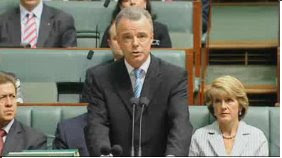
- I have little doubt that Dr Brendan Nelson is a good man. Really. He was clearly affected by the notion of taking children away from their parents, by his experiences in indigenous communities, by the emotional presence of dozens of members of the stolen generation. His task today was utterly thankless. But it was also self-inflicted. Had he stood with Malcolm Turnbull, weeks ago, and said unequivocally that he would support an apology offered by the government, he could today have given full voice to the compassionate doctor within. He could've played gracious statesman, transcending partisanship to right an old wrong. But he did not. So he was stuck blending compassion with occasional, strange detours into petrol-sniffing and ANZACs, obvious bones to the dogs of the hard right. And he pleased nobody.
- Watching Nelson squirm as Rudd announced the Bipartisan War Cabinet: solid gold.
- My hero: Tom Calma. I've had the pleasure of meeting him, and it's hard to imagine someone whose decency and intelligence and compassion are more clearly and immediately in evidence. If he weren't so busy healing race relations, and if I weren't a republican, I would suggest him for Governor-General.
- Paul Keating was in his element talking, post-apology, on ABC TV. Eloquent about indigenous disadvantage, generous about Rudd, scathing about John Howard. His view on Howard's non-appearance: it's a disgrace that he wasn't there, but consider the alternatives. To show up in support would've been rank hypocrisy; to show up in protest unthinkable. So his staying away was the best that could've happened. Still, for shame.
- And speaking of shame, the black list of Opposition MPs who didn't show:
- Wilson Tuckey (who nonetheless managed to make it to the Lord's Prayer, directly before)
- Alby Schultz
- Sophie Mirabella
- Don Randall
Add to that Chris Pearce, who remained seated throughout and read a magazine. I'm not saying we should steal their kids, but a keyed car or two wouldn't go astray.


Tuesday, February 5, 2008
Keelty Update
Sometimes, you just wish you hadn't opened your big mouth, right, Mick?
With his quasi-totalitarian suggestion of a media blackout during terror cases, Keelty has managed to unite, in one fell swoop, a number of disparate groups. Well, one might expect those bleeding hearts in the Council for Civil Liberties to be against it. And the Rudd troops have demonstrated much less squeamishness over the Haneef case in government than it did in opposition: first McClelland, then Rudd himself condemned Keelty's argument.
But then, to add insult to injury, the Opposition's justice spokesman, Chris Pyne, joined the chorus. Pyne is, to be sure, one of those Libs - they do exist - whose past record has a faintly suspicious whiff of humanity about it; he's a moderate who's been known, for instance, to voice concern about certain aspects of the Howard government's immigration policy. But that was as a backbencher; now, he is speaking in an official opposition capacity. If Keelty can't rely on the Libs' spokespeople to maintain their support, who can he turn to?
Of course, there's always someone. And that someone is, as usual, Gerard Henderson. Ah, Gerard: lone voice in the wilderness, brave contrarian flying the flag for the AFP, taking the fifth-estate consensus and ripping it apart with nary a care for his own interests. In these confusing, apology-offering, Kyoto-signing times, it's good to know that some things will never change.
So what's the argument? Sez Gerard:
I see. There is a distinction between the media advising police how they should behave, which is non-binding and constitutional, not to mention part of the intended function of the media, and the police suggesting, seriously, that the media should be dealt blanket legal restrictions forbidding them to publish details of terror cases on the off-chance that what the media has to say might damage the credibility of the case put forward by police. One is part of the checks and balances of a democratic society; the other runs directly counter to them. But never mind. Next objection?
All true. Lots of us, even outside the meejah, don't approve of Australia's 'updated' national security laws, which were, apart from anything else, of dubious constitutionality. I, for one, would rather expect laws expanding executive power and suspending habeas corpus to cop a hiding in the press. But we're not really talking about an interpretive matter here: Keelty is mostly peeved that The Australian - the Australian! - published a full transcript of the Haneef interview. To quote from the great cop himself:
With his quasi-totalitarian suggestion of a media blackout during terror cases, Keelty has managed to unite, in one fell swoop, a number of disparate groups. Well, one might expect those bleeding hearts in the Council for Civil Liberties to be against it. And the Rudd troops have demonstrated much less squeamishness over the Haneef case in government than it did in opposition: first McClelland, then Rudd himself condemned Keelty's argument.
But then, to add insult to injury, the Opposition's justice spokesman, Chris Pyne, joined the chorus. Pyne is, to be sure, one of those Libs - they do exist - whose past record has a faintly suspicious whiff of humanity about it; he's a moderate who's been known, for instance, to voice concern about certain aspects of the Howard government's immigration policy. But that was as a backbencher; now, he is speaking in an official opposition capacity. If Keelty can't rely on the Libs' spokespeople to maintain their support, who can he turn to?
Of course, there's always someone. And that someone is, as usual, Gerard Henderson. Ah, Gerard: lone voice in the wilderness, brave contrarian flying the flag for the AFP, taking the fifth-estate consensus and ripping it apart with nary a care for his own interests. In these confusing, apology-offering, Kyoto-signing times, it's good to know that some things will never change.
So what's the argument? Sez Gerard:
Journalists, editors and producers are invariably willing to advise police how they should behave but do not appreciate being told what they themselves should do by police.
I see. There is a distinction between the media advising police how they should behave, which is non-binding and constitutional, not to mention part of the intended function of the media, and the police suggesting, seriously, that the media should be dealt blanket legal restrictions forbidding them to publish details of terror cases on the off-chance that what the media has to say might damage the credibility of the case put forward by police. One is part of the checks and balances of a democratic society; the other runs directly counter to them. But never mind. Next objection?
Also, many in the media do not approve of Australia's updated national security laws which were passed by the Howard government, with the support of the Labor Opposition, following the terrorist attacks on the US on September 11, 2001.
All true. Lots of us, even outside the meejah, don't approve of Australia's 'updated' national security laws, which were, apart from anything else, of dubious constitutionality. I, for one, would rather expect laws expanding executive power and suspending habeas corpus to cop a hiding in the press. But we're not really talking about an interpretive matter here: Keelty is mostly peeved that The Australian - the Australian! - published a full transcript of the Haneef interview. To quote from the great cop himself:
... we are now witnessing these records of interviews being leaked to the media to add weight to public campaigns. When a "record of interview" is given to the media with accompanying commentary, we run the risk of jeopardising the accused's ability to receive a fair trial when the matter reaches court. It is also only one part of the greater body of evidence, and when considered in isolation it may serve as a public relations tool in the short term, but it has the potential to severely harm a case in the longer term.
Translation: this is not merely a crusade against soft-on-terror writers of opinion pieces. It's factual reporting Keelty is opposed to. Get it?
Look, Gerard. We all understand that you're feeling a little beleaguered in the post-Howard era. There are certain socially acceptable remedies available to you; one would understand if you felt like turning to the bottle, or perhaps kicking the cat around a little. But defending Mick Keelty's call for a media blackout is not the way to cope. It makes you look silly, and it alienates you from your peers. Chris Pyne has proven he knows which way the wind is blowing. It's probably time you took heed.
Wednesday, January 30, 2008
What Your Reading Material Says About You: Dodgy Facebook Stats Edition
In a feat of statistical analysis only a market researcher could love, these people have correlated Facebook users' self-reported favourite books with their colleges' mean SAT scores. Yeah, I know, but it's all in good fun. And there's a lot to like about the results, even if the methodology's suspect: Lolita and García Márquez are awesome, 1984 is way better than Animal Farm, and the less said about university students who still list "The Holy Bible" as their favourite book, the better. Also, turns out crappy schools are more likely to attract people who don't realise Hamlet is a play, not a book. Sounds about right to me.
Mick Keelty and the Logic of Public Scrutiny
Is it just me, or has cop-in-charge Mick Keelty been acting a little… unhinged ever since the Mohammed Haneef case?
Exhibit A for the prosecution: Keelty's address to the Sydney Institute last night, in which he criticised the media for reporting on high-profile terrorism cases and subjecting the powers-that-be to rigorous and sometimes unfriendly scrutiny. You know the drill. I think it's known in some circles as "doing their job".
Keelty's complaint is that the media have been so busy reporting on cases such as the Haneef prosecution, airing facts in the public sphere, humanising the would-be defendants, and so forth, that the judicial process doesn't stand a chance. Which is just a little rich on a few different levels. Namely:
1. Time and again, the media has wielded its opinion-making power in a way that is most favourable to the public prosecutors. I'm looking at you, Murdoch press. One hardly needs to open the Daily Telegraph to encounter an example of journalists and editorial writers whipping up a public frenzy against the minor recalcitrant du jour. Due process? Forget it. Keelty might be disappointed that this handy little coin has a flip side, but he can hardly claim to be surprised.
2. Er, the burden of proof rests on the prosecution. Innocent until proven guilty, as the legal phrase has it. The media are supposed to cover criminal cases as though the defendant is innocent. Remember? If the cops can't make the case for the defendant's guilt in the face of a little media scrutiny, they can't make the case at all.
3. Re. the Haneef case: it's been so long that perhaps our collective memory of the events is a little hazy. So, a little refresher on Haneef-case chronology. First, the AFP themselves released highly selective excerpts from the interview, the cumulative effect of which was to lie about Haneef's association with terror suspects. Then, Haneef's lawyer, Stephen "Atticus Finch" Keim, released the whole transcript to set the record straight. Now, it's understandable that the AFP were embarrassed by the release of the full transcript, in all its computer-illiterate, geographically shaky, Ramadan-ignorant glory. But that's hardly the media's fault. Is it really Keelty's contention that justice would've been better served had the media's knowledge of the case been based solely on AFP-approved "facts"?
4. While we're on the subject of extraneous bodies influencing judicial matters, how about a little shout-out to then Immigration Minister, Kevin Andrews, who, at the behest of the Australian Federal Police (yes, that AFP) cancelled Haneef's visa, thus effectively overriding the decision of the judiciary to grant Haneef bail? Or are we not supposed to be concerned about that kind of extrajudicial interference?
5. If you purport to be concerned, as Keelty does, about the erosion of public confidence in your institution, you're probably not doing your cause any favours by waxing totalitarian. So rather than calling for "a halt to criticism of public institutions", how about you focus on cleaning up your own act? The media can only report on what happens, after all.
Attempting to preserve secrecy is not, of course, an uncommon reaction to the threat of terrorism. But it is an irrational one. The seriousness of the charge lends more, not less, weight to the importance of due process; and the heightened powers of the police render it more, not less, important that the media scrutinise that process. Confidence in public institutions can only be achieved if the workings of those institutions are exposed to the public. In the Haneef case, the AFP and Andrews failed the accountability test miserably. But that is cause for greater accountability, not easier tests.
* * * * * * * * * * *
UPDATE: Writing in Crikey for us subscriber-freaks, Greg Barns has a similar take: "The idea that Keelty and his colleagues should be allowed to brief editors of media outlets on a secret basis in terrorism investigations, while at the same time preventing lawyers acting on behalf of those being investigated speaking to the media, is so absurd, that one wonders if this man has really lost the plot."
Friday, January 11, 2008
US Candidates: The Issues
Doing the rounds of the internet at the moment: a political compass test for US presidential candidates. See how you compare!
Here are my results:

Rather comforting, actually. After all the commentary I've read about John Edwards being the true progressive in the race, I was beginning to worry that my Obama/Clinton leanings were informed by white liberal guilt, or feminist overcompensation, or misplaced nostalgia for the Clinton era, or the fact that Obama looks good behind a lecturn. Well, they probably are, but at least now I can claim 81% policy convergence with Obama, and 78% with Clinton. John Edwards is just behind; Bill Richardson, whose staffer emails I have unaccountably received all campaign, is my least favourite Dem (but he dropped out this morning, so that's ok). And I detest everything Fred Thompson stands for, which is fine by me.
Wednesday, January 9, 2008
New Hampshire Intrigue
For those of us who just can't get enough of politics, US primary season is already up and running. (And we complain about our six-week election campaigns.) The commentariat was abuzz on the weekend with the twin surprise out of Iowa: Huckabee over Romney, Obama over Clinton. Now we're in New Hampshire, where John McCain has won in a big way, and Clinton has reversed the tide yet again with a narrowish win over Obama, just as people were beginning to predict an Obama domino effect. Isn't politics fun when you have no vested interest in the outcome?
Conventional wisdom in much of the non-US world has it that Barack Obama does not stand a chance: the American electorate is just not ready to elect an African-American president, especially not a Democrat. Obama, though, is a uniquely appealing candidate for people who might otherwise be subconsciously wary of electing a non-white. He's young. He's nonthreateningly handsome. His rhetoric is cerebral rather than muscular. He speaks not with the populist outrage of John Edwards – that would be a bridge too far – but inspiringly, optimistically. He loves to invoke lofty ideals like unity and "post-partisan politics". He makes people feel good about voting for him.
And perhaps as a result, moderate Republicans don't hate him; at least, not nearly as much as they hate Senator Clinton. Obama's big achievement in Iowa was to mobilise self-identified independent and even Republican voters. Pretty good for a guy who voted against the Iraq war from the outset. Of course, the campaign hasn't been entirely free of nastiness - the 'rumour' doing the rounds that Obama is a 'secret Muslim' comes to mind - and one can certainly expect an escalation of this kind of thing should Obama win the nomination. But so far, so good, at least as far as race-baiting goes.
Now Obama's problem, such as it is, appears to take a somewhat different form: people – certain people - don’t take him seriously. I'm calling this phenomenon Obama's Jonathan Franzen problem. Franzen, you may remember, was none too pleased when Oprah endorsed his critically-acclaimed novel The Corrections as part of her book club. The author felt this cheapened him as an artist, robbed him of his intellectual credibility among the elites he felt to be his natural readership.
Famously, Oprah has now endorsed Obama for President, providing him with a useful injection of popular support. Oprah is staggeringly influential, and when she says Vote Obama, people - certain people - listen. (The cultural implications of this I will leave for a later discussion.) But it's also had the effect of tagging Obama the Oprah Candidate, which, while not particularly damaging in itself, manages to encapsulate a lot of the arguments of the anti-Obama camp: too young, too inexperienced, style over substance, celebrity over policy.
Much of this criticism is valid; 46 is young for a President, and one term in the US Senate is not exactly a substantial resume. But Obama is no fresh-off-the-turnip-truck naif, either. Besides, as job descriptions go, being POTUS is utterly unique. Every other 'experience' up to this point can hardly be expected to prepare the candidate for the actual presidency - even, dare I say, the experience of being married to a two-term prez.
At any rate, given the New Hampshire result, the race for the Democratic nomination is looking suddenly more interesting. Meanwhile, those crazy Republicans vacillate between McCain and Huckabee… it's nice to see the conservatives riven by internal conflict for a change.
Thursday, December 13, 2007
Freedom '08
The Herald has an exclusive today about the New South Wales Government's plan to enact emergency laws during next years World Youth Day conference. Leaving aside the religious aspect, I have to say I'm getting a little sick of having my civil liberties periodically restricted just because I have the hide to live in a temperate, good-looking city. I'm all for encouraging tourism, but not if that entails John Watkins acting like Pervez Musharraf every time a big event comes to town. Emergency laws? Excuse me, but an appearance by a leading religious figure does not constitute an emergency.
Perhaps the most alarming aspect of all this is the muted response laws like this seem to generate. Oh, sure, people grumble, in much the same way people grumble about their local council cracking down on overhanging branches. But the potential for abuse - and the precedent set by the government enacting new, authoritarian legislation whenever they feel like it - doesn't really seem to hit home.
I'm not trying to pull a Naomi Wolf here. I don't really think Supreme Leader Watkins is about to start sending in the army every time someone stages a protest, and heaven knows Iemma has neither the drive nor the competence to do so. But people are getting so accustomed to having this or that event invoked as a pretext for upping the city's Laura Norder quotient, one begins to suspect that such an action would barely raise an eyebrow. It's sad, and it's dangerous. Remember these images? They're out of place in any democracy, let alone one with a supposedly proud anti-authoritarian tradition.
Of course, the NSW Opposition, many of whom would be quite happy as members of Generalissimo Franco's goon squad, didn't object to the laws per se, at least not as the bill was being debated (to their credit, the Legislative Review Committee did raise serious objections). Instead, the Libs' Jonathan O'Dea took the opportunity to provide a few helpful suggestions of his own:
Quite. The Chaser provided the only moment of sanity of the entire APEC saga. It cannot be allowed to happen again.
Perhaps the most alarming aspect of all this is the muted response laws like this seem to generate. Oh, sure, people grumble, in much the same way people grumble about their local council cracking down on overhanging branches. But the potential for abuse - and the precedent set by the government enacting new, authoritarian legislation whenever they feel like it - doesn't really seem to hit home.
I'm not trying to pull a Naomi Wolf here. I don't really think Supreme Leader Watkins is about to start sending in the army every time someone stages a protest, and heaven knows Iemma has neither the drive nor the competence to do so. But people are getting so accustomed to having this or that event invoked as a pretext for upping the city's Laura Norder quotient, one begins to suspect that such an action would barely raise an eyebrow. It's sad, and it's dangerous. Remember these images? They're out of place in any democracy, let alone one with a supposedly proud anti-authoritarian tradition.
Of course, the NSW Opposition, many of whom would be quite happy as members of Generalissimo Franco's goon squad, didn't object to the laws per se, at least not as the bill was being debated (to their credit, the Legislative Review Committee did raise serious objections). Instead, the Libs' Jonathan O'Dea took the opportunity to provide a few helpful suggestions of his own:
In light of the recent APEC experience, I particularly urge the Government to consider better ways of dealing with the ABC Chaser team. The boys are quick and imaginative in their endeavours to amuse television audiences. Asking them to sign a post-APEC good behaviour bond would only set their minds in overdrive. I therefore suggest that the New South Wales Government provide funding to get them out of Australia for the week. How about sending them to the Kalahari Desert to investigate humour in 45 degrees heat or to Russia for lessons on how to behave solemnly? Perhaps they could be sent to China and India, as Premier Iemma was before the recent Federal election to save Kevin Rudd from further embarrassment.
Quite. The Chaser provided the only moment of sanity of the entire APEC saga. It cannot be allowed to happen again.
Wednesday, December 12, 2007
Doris Lessing's War on Everything
So Doris Lessing has used her Nobel Prize acceptance speech to hit out at the internet. The internet! What is behind this? Could it be a simple case of viewing one lolcat too many? Or was Doris, like so many of us, just annoyed to have found herself spending an hour idly clicking around Wikipedia, touring through the pages on salamander and mercantilism and Bobby Darin only to lose track of her original purpose?
Oh no. Lessing is worried that the internet is leading us to our ruin, specifically by dumbing us down. We are turning into a society of ignorant, barely literate, jaded automatons. People specialise in one thing - computers, most gratingly - and don't stray from their field of expertise. Nobody reads anymore. Young people know nothing, and also quite probably chew with their mouths open, although Lessing doesn't find time to mention it.
Could she be right? I think, if anything, I read more - and more widely - than I would if the internet had not been invented. Here is a snapshot of browser windows I had open when I chanced upon the Lessing article. (Please note it was a quiet-ish day at work.)
1. The Sydney Morning Herald - "Net dumbs us down"
Even without the internet, I would almost certainly read a print newspaper every day. I always used to. But equally certainly, I would read different stuff. The article on Lessing would probably never have reached me, hidden as it was in the Tech section, which is generally of no interest to me, and gets thrown out every Saturday, when I do buy the print Herald. In fact, in eradicating the physical barriers between interest sections, the online version probably leads to more branching out of one's interest area, not less. What's more, when I buy the print Herald, I read it on the bus, which takes away time I would normally spend... reading a book.
On the other hand, when I have the paper in hard copy, I always end up doing the cryptic crossword, which I don't like online. It's too hard to mark up, and too easy to cheat.
2. The Guardian, A Hunger for Books
The full text of Lessing's speech, which I googled on reading the article to ensure she wasn't misquoted or taken out of context by the Herald. Checking the context seemed like the fair thing to do. One hardly needs to point out... oh, go on then: this would not have been possible without the internet.
3. The New Yorker, None of the Above, by Malcolm Gladwell
A neat summary of a debate about the statistical IQ gap between races and its implications, with particular reference to the Flynn Effect. I have been following this issue with some interest, although without any scientific expertise. See, it all started when Slate published a series of articles by William Saletan in which he argued that the racial IQ gap was genetic and immutable. This did the rounds of the blogs, including Matthew Yglesias, where I was alerted to it, and naturally sparked a great number of fiery arguments, particularly when it turned out that Saletan's reportage was informed largely by fruity white supremacists. (Duh.)
Being kind of a tosser, I can easily imagine that I would spend perfectly good caipirinha money on the print New Yorker in the absence of an online version. So I would've read Gladwell's article. But I would have had no context outside what the article provides - I wouldn't have read Saletan, nor would I have any idea of the uproar his work had caused. I could have guessed, but I wouldn't have experienced it myself. Also: it was reading Gladwell's blog, as well as the Freakonomics blog, that convinced me to buy his books "The Tipping Point" and "Blink". Do we still think the internet discourages reading?
4. 150 UK pounds in Euros
This is actually for work. I am the office converter of pounds to Euro, miles to kilometres, etc. I keep trying to tell my colleagues about Google Conversions, but they insist that I "do it quicker". This is quite possibly the result of belonging to a generation that has never had cause to doubt that the answer is at our fingertips. If something unfamiliar - a place, a person - comes on the news, someone immediately goes to the computer (that would be the spare computer, beside the television) to find out about it.
How can this mean we know less? We might retain less arcana, because we know we can always retrieve it later. But I even doubt that part, because the internet lends itself to broadening the search, so that each piece of trivia eventually gets a context, something to link it to all the other stuff we've found out about. There's no better way to remember something than to relate it to what you already know. I read that online somewhere.
5. The Economist, Defeat for Hugo Chávez
Like the New Yorker, the Economist is something I can imagine reading in print... or half-reading in print, and then leaving, crumpled, under the passenger seat of my car along with the half-read, crumpled New Yorker. (This is slightly more than just an educated guess. I hereby apologise to the old-growth forests of Tasmania that have died for my sins.) The refined classical liberals at the Economist take a dim view of Mr Chávez, but that's okay, because John Pilger thinks he's God's gift to poor people, and I saw Pilger's film too. It's all about balance.
6. Programme for International Student Assessment, 2006 results
I was led to this through an Economist article outlining the educational attainment of various countries. I wanted to check how Australia measured up. Not too badly, it turns out - our achievement band contains some reassuringly Scandinavian countries, as well as some Asian New Economies. Our performance in reading is slipping, though. Must be all that internet surfing.
7. Crikey: Brendan Nelson: Rat, coward or liar... you decide, Guy Rundle
Crikey is irreverent, contrarian, openly non-objective, and obsessed with the insiders' world of politics and media. It publishes contributions from Gerard Henderson and Robert Manne and GetUp and David Flint. It gets down and dirty with polling-by-electorate data and publishes anonymous "Tips and Rumours" from deep within Canberra's bowels. Its readers - who can and do comment on each story - are sometimes morons and often astoundingly well-informed. In short, Crikey epitomises much of the internet's effect on political discourse. Would we be better off without it? Like hell we would. Consider the Lie Matrix in the Rundle article I linked, showing the rather unpalatable choice of interpretations one has regarding Brendan Nelson's backflip over "never voting Liberal":
You don't get that in Doris Lessing books.
* * * * * * * * * * *
It's probably too easy to take an 88-year-old to task over her views of the internet. It's certainly easy to wax nostalgic about books, and I share her wish that more people would read more literature. But this notion of a past populated by erudite book-readers is at best overly romantic, and saying the internet is dumbing people down is erring dangerously close to grumpy-old-lady knee jerking. People still read. People still read books. As for the internet, it is what you make it: there's a lot of crap out there, but there's a lot of useful things, too. We need to spend less time bitching about Yoof These Days and more time teaching people the difference.
Subscribe to:
Posts (Atom)